
It usually starts small. A parent needs a ride to an appointment. Then help with groceries. Then help getting dressed. And then, one night, you’re awake at 3am doing something you never imagined doing for the person who once did it for you.
No one applies for this job. There’s no interview, no training, no salary. And yet it has quietly become one of the largest occupations in the United States. Here’s what the data actually says about it.
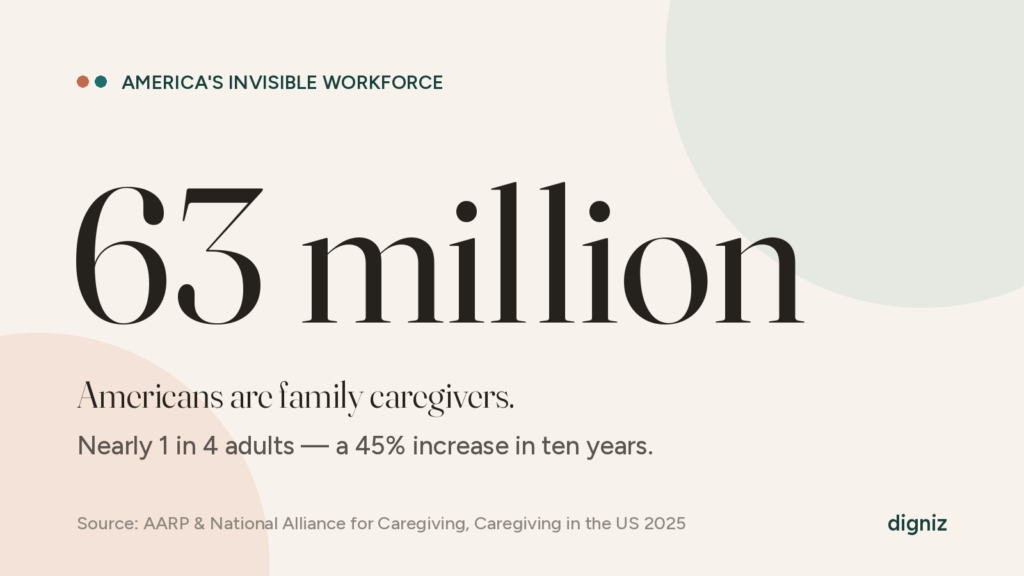
1. There are 63 million family caregivers in America — nearly 1 in 4 adults.
According to Caregiving in the US 2025, the landmark study by AARP and the National Alliance for Caregiving, 63 million Americans provided ongoing care to an adult or a child with a serious condition or disability in the past year. That’s a 45% increase since 2015 — twenty million more caregivers in a single decade. If family caregivers were a state, they’d be the largest state in the country by population.
2. For 1 in 4 of them, it’s a full-time job. Unpaid.
Nearly one in four caregivers reports providing 40 or more hours of care per week — the equivalent of a full-time position, on top of whatever else life demands. Three in five caregivers also hold paying jobs, and half of those report work disruptions like arriving late or leaving early to handle care. And this isn’t a short season of life: 30% have been caregiving for five years or more.
3. Two-thirds now help with the most intimate tasks of daily life.
The image many people have of caregiving — driving to appointments, picking up prescriptions — is out of date. Today, 65% of family caregivers assist with at least one activity of daily living: bathing, dressing, feeding, mobility, and toileting. The care happening in American living rooms and bedrooms today is the kind of care that, a generation ago, mostly happened in hospitals and nursing facilities.
4. Only 11% have ever received training for it.
Here is one of the most striking gaps in the entire dataset: while more than half of family caregivers now perform complex medical and nursing tasks, only about 11% have received medical training to assist with daily-living activities. We would never send a professional aide into this work untrained. We send millions of daughters, sons, and spouses into it every single day.
5. More than half of homebound older adults live with incontinence.
This is the statistic almost no one talks about, because the topic itself is taboo. Clinical reviews report that over half of homebound older adults experience incontinence — caregiver-reported figures put it at 53%. That means for millions of families, the single most frequent, most physical, most emotionally loaded task of the day is one that rarely gets mentioned outside the home: the change. Several times a day. Every day. Often in the middle of the night.
The silence around this task doesn’t make it lighter. It just makes the people doing it feel more alone.
6. Professional caregivers get injured at three times the rate of construction workers. Families do the same lifts — untrained.
Bureau of Labor Statistics data shows that nursing assistants and orderlies suffer musculoskeletal injuries at roughly three times the rate of construction laborers, with more than 35,000 back and other injuries a year severe enough to miss work. The number one cause: lifting and moving patients.
Now consider that family caregivers perform many of those same lifts and turns — often for a person who weighs more than they do — with no lifting equipment, no team, and, as we saw above, almost no training. The professional numbers are the visible tip of an iceberg that mostly sits, unmeasured, inside private homes.
7. The caregivers’ own health is paying the bill.
One in five family caregivers reports being in fair or poor health, and nearly one in four say they struggle to take care of their own health because of caregiving responsibilities. Emotional stress has risen since 2020. Caring for someone you love shouldn’t have to mean slowly becoming a patient yourself — but for millions, that’s exactly the trade being made.
8. All of this unpaid work is worth about $1 trillion a year.
AARP’s Valuing the Invaluable 2026 report estimates that family caregivers provided 49.5 billion hours of unpaid care in 2024 — an economic value of roughly one trillion dollars. That’s more than all health care spending by private businesses ($967 billion) and more than the entire Medicaid program ($932 billion) in the same year.
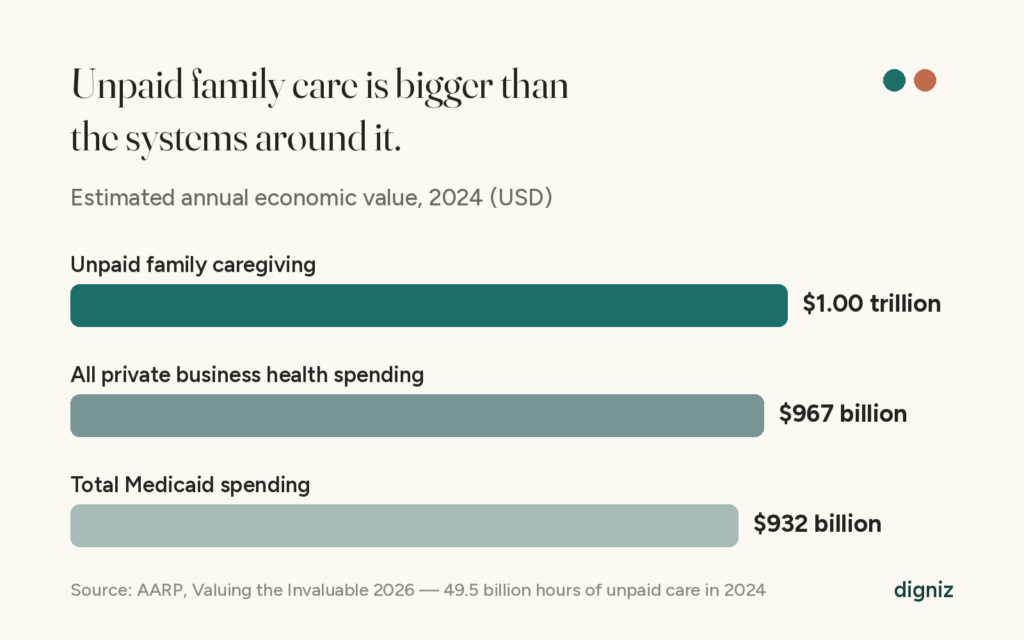
In other words: the largest long-term care system in America is not Medicaid, not insurance, not nursing homes. It’s families.
What these numbers add up to
Read together, these eight numbers tell one story. An enormous, growing, invisible workforce is doing physically punishing, emotionally heavy, hospital-grade work at home — untrained, unpaid, and largely unsupported. And the hardest parts of that work are precisely the ones we’ve made hardest to talk about.
We believe the next decade of home-care innovation has to start exactly there: at the tasks no one talks about, in the hours no one sees, for the people doing the heaviest lifting — literally — in American family life. That belief is why Digniz exists. We’re building for the moment at 3am, for the backs and the sleep and the quiet dignity of everyone in the room.
Sources
– AARP & National Alliance for Caregiving, Caregiving in the US 2025 (July 2025) — aarp.org/caregivingintheus2025
– AARP Public Policy Institute, Valuing the Invaluable 2026
– NCBI StatPearls, Urinary Incontinence (caregiver-reported prevalence among homebound older adults)
– Shamliyan et al. / PMC, Conservative Interventions for Urinary Incontinence in Frail Community-Dwelling Older Adults (prevalence among homebound adults)
– U.S. Bureau of Labor Statistics, Survey of Occupational Injuries and Illnesses; NPR investigative series on nursing injuries (2015)
Digniz publishes this blog for families and professionals navigating home care. Nothing here is medical advice; statistics are drawn from the cited public sources.